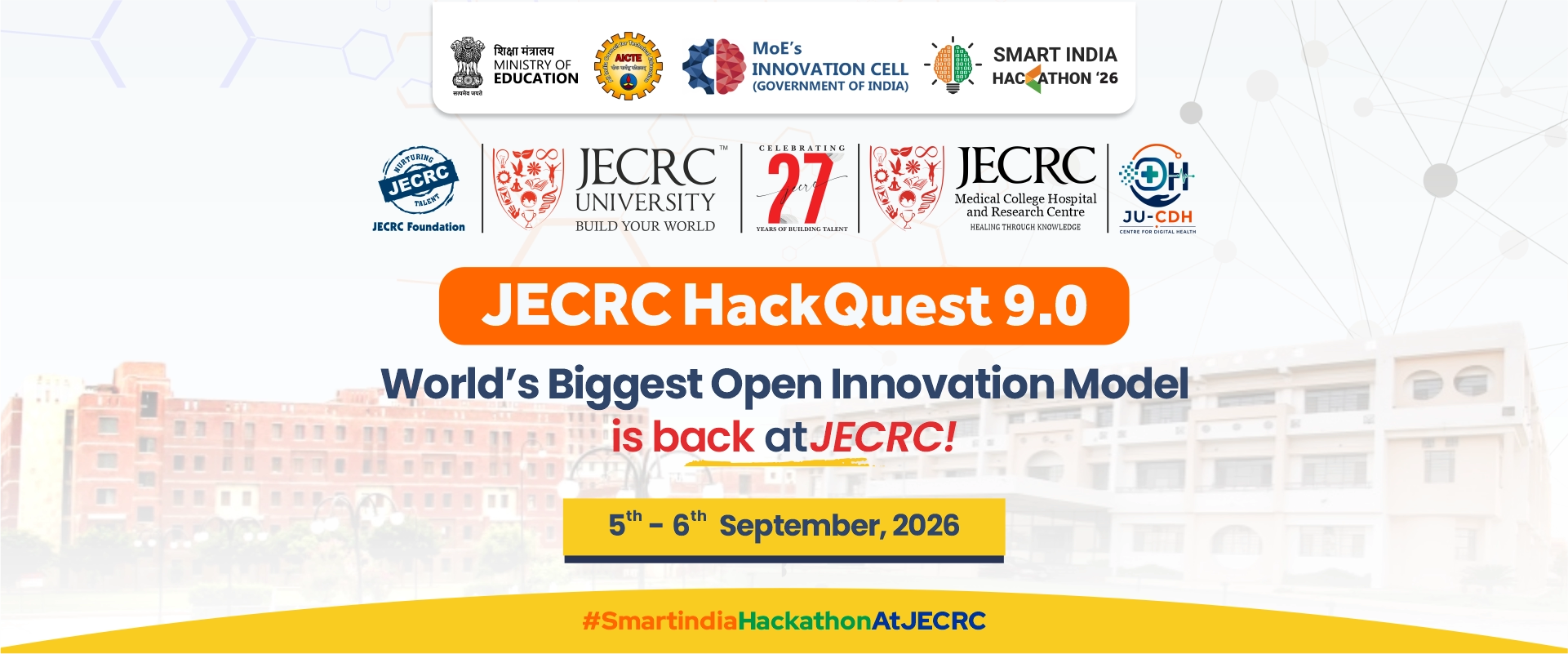
Prelims of Smart India Hackathon 2026 Banner

Prelims of Smart India Hackathon 2026

JECRC University, Jaipur
5–6 September 2026
36-Hour Innovation Challenge
Think. Innovate. Build. Solve for India.

The Prelims of Smart India Hackathon (SIH) 2026 at JECRC University will bring together student innovators to identify real-world challenges, develop technology-driven solutions and compete for an opportunity to represent JECRC at the national level.

With JECRC's strong legacy of hosting and participating in Smart India Hackathon, the 2026 Prelims aim to create an intensive environment of innovation, collaboration, mentorship and problem-solving.

Team Formation

Build Your Dream Team

Each participating team must be formed according to the SIH 2026 guidelines.

Team Size

6 Students (Minimum 1 Girl Member)

Team Composition

  • One student will act as the Team Leader.
  • The remaining students will be Team Members.
  • Teams should preferably represent diverse technical and functional skills.
  • Students from different branches/disciplines of JECRC may collaborate wherever permitted.
  • Team registration will be completed by the Team Leader.

Recommended Team Skills

AI/ML • Data Science • Web & App Development • IoT • Cloud • Cybersecurity • UI/UX • Electronics • Domain Expertise • Business & Entrepreneurship

One Team. Six Minds. One Solution.

Registration

Register Your Team

All eligible teams must complete the JECRC SIH 2026 Prelims registration process within the announced registration window.

Registration Fee

1800/- per Team

Registration Deadline

25-Aug-2026

First 250 registered Teams will be Considered for Hackathon

Registration includes:

  • Participation in the 36-hour hackathon
  • Access to the event venue & Mentorship
  • Evaluation by expert judges
  • Food & refreshments during the event
  • Participation certificate

Important: The Registration fees will be collected offline after 25-Sept-2026.

Register Now

Problem Statements

Choose a Problem. Create an Impact.

Participants will develop solutions around the official SIH 2026 Problem Statements.

Problem Statement Categories

Depending on the final SIH 2026 list, problem statements may cover areas such as:

AI & Machine Learning
Healthcare & Digital Health
Education & Skill Dev.
Cybersecurity
Agriculture
Smart Cities
Sustainability
FinTech

Idea / PPT Submission

Turn Your Idea into a Compelling Story

Every participating team will prepare its solution presentation using the prescribed JECRC SIH 2026 Idea PPT Template.

Recommended PPT Structure

Slide 1 — Team & Problem Statement

  • Team Name
  • Team ID
  • Problem Statement ID
  • Problem Statement Title
  • Team Members

Slide 2 — Problem Understanding

  • What is the problem?
  • Who is affected?
  • Why does the problem matter?

Slide 3 — Proposed Solution

  • Your idea
  • Core concept
  • Key features

Slide 4 — Innovation & USP

  • What makes your solution different?
  • Innovation compared with existing solutions

Slide 5 — Technology Stack

  • AI/ML
  • Web/Mobile
  • Cloud
  • IoT
  • APIs
  • Database
  • Other technologies

Slide 6 — Solution Architecture

  • Show the complete architecture/workflow.

Slide 7 — Prototype / Working Model

  • Screenshots
  • Demo
  • Prototype
  • Hardware model, where applicable

Slide 8 — Impact & Scalability

  • Target beneficiaries
  • Expected impact
  • Scalability
  • Deployment possibilities

Slide 9 — Implementation Plan

  • Development roadmap
  • Resources required
  • Future enhancements

Slide 10 — Team

  • Team Leader
  • Team Members
  • Roles & responsibilities

Download Template

Download SIH 2026 Idea PPT Template

Tip: Keep the presentation visual, concise, and evidence-driven. The jury should understand your problem, solution, innovation, feasibility, and impact within a few minutes.

Event Flow

36 Hours of Innovation

Sept. 5th : Day 1

Time Activity
9:00 -10.00AM Registration/Reporting of all teams - All Team Leaders
10.00-11:00 AM Inauguration –– D Block Auditorium(JECRC foundation)
11.00AM – 2:00PM Evaluation of Idea Presentation by Internal Panel for JECRC teams @A & C block venues
12:.30PM – 3:30PM Evaluation of Idea Presentation by Internal Panel for JU teams @D block venues
5:00 PM Result Announcement
Selection of Top 50 teams, both from JC and JU
7:00 PM Coding Starts (50 + 50 Teams) - JU Cafeteria
9:30 PM -10:30 PM Dinner (For Guests and Teams)
11:00 PM – 12:00 Midnight Mentoring Session by Industry Experts
Coding Resumes

Sept 6th : Day 2

Time Activity
01:30 AM Midnight Snack
01:30 AM-2:00 AM Rejuvenating Activity / Camp Fire
2:00 AM Coding Resumes
2:00AM-3:00 AM Mentoring Session by Internal Panel
6.30 AM Yoga Session
7:00 AM-9:00 AM Break
9:00 AM-10.00 AM Breakfast
10:00AM-12:00 Noon Second Round of Evaluation ( 8 Panels - 4 for JU teams + 4 for JC teams)
12:30 PM-1:00 PM Power Judging
1:00 PM - 2.00 PM Valedictory
2.00 PM - 3:00 PM Lunch (Teams & Judges)

Evaluation Criteria

1. Approach to the Solution of the Problem Marks
The solution only solves a generic technical / IT problem and does not address the requirements for the given Department’s problem. 1 to 4
The solution partly addresses the problem or gives a unique solution but it may not be extendable into a platform for larger impact. 5 to 8
The approach gives the complete solution of the problem to full extent with all the parameters being properly covered. 9 to 10
2. Presentation Marks
Presentation was quite basic and did not address the problem statement. 1 to 4
Solution not clearly presented and lack of systematic presentation. 5 to 8
Good presentation and addressed the problem and solution up to the mark. 9 to 10
3. Innovations and Technology Used Marks
Regular solution, no innovation. 1 to 4
Solution has been designed using innovative ideas and latest technologies. 5 to 8
Solution is well thought out and is something extremely unique. 9 to 10
4. User Experience Attributes Marks
Not useful for the user perspective 1 to 4
Partly usable for the user perspective and partly the requirements of problem statement 5 to 8
Extremely useful for the user perspective and satisfy the requirements of problem statement 9 to 10
5. Execution Attribute/ Demonstration Marks
Problem not executed properly, no demo given 1 to 4
Partial working demo to be able to showcase solution to the problem or usable and working demo but some development missing. 5 to 8
Completely working prototype of demo which can be repetitively executed. 9 to 10
6. Social Impact Marks
Regular solution, no social impact. 1 to 4
Solution has been designed with moderate social impact on society 5 to 8
Solution is unique, well designed and has strong impact on social perspective. 9 to 10

Jury Perspective
Don't just show what you built. Show why it matters.

Mentorship

Build Better with Expert Guidance

Throughout the hackathon, participating teams will have access to mentors from industry, academia, technology and relevant domain areas.

Mentors can help teams with:

Problem understanding Technology selection Architecture Product development Business model Scalability Presentation

Mentorship is guidance—not a substitute for the team's own solution.

Important Rules

Code of Conduct

Participants Must:

  • Register with accurate information.
  • Work only on the selected problem.
  • Respect intellectual property.
  • Follow JECRC University discipline.

Teams Should Not:

  • Plagiarize existing solutions.
  • Misrepresent third-party work.
  • Submit false information.
  • Violate software licensing.

Contact Us

We're Here to Help

SIH 2026 Prelims – JECRC University

JECRC University, Jaipur, Rajasthan

For registration, technical assistance and event queries:

Email Us

[email protected]

WhatsApp

9887719192